
Every wire stripping need belongs to one of four machine families, and most buying mistakes come from comparing machines across families as if they were the same class. This overview maps the four families — what each is built for, which real machine represents it, and the jobs it fits — so you can start from the right family and then compare within it.
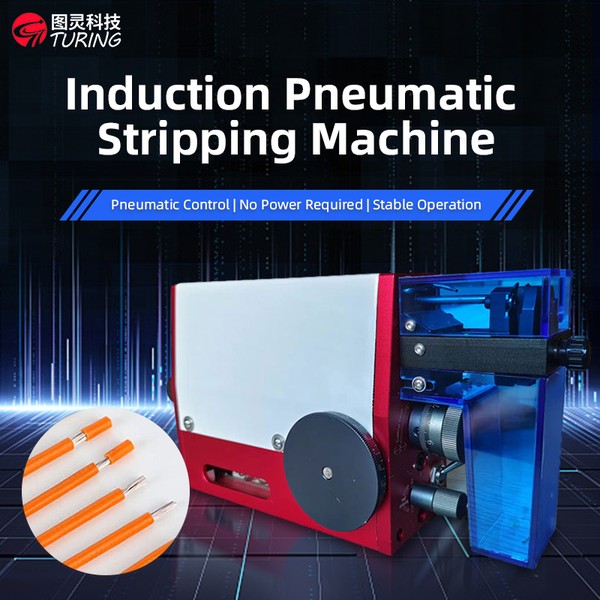
Family 1 — pneumatic bench strippers: fast setup, operator control
For a shop that strips many different short runs with an operator at a bench, a pneumatic semi-automatic stripper is the practical tool: compressed-air blades, a foot or button trigger, and quick die changes. The TR-QD15 semi-automatic pneumatic wire peeling machine is the bench machine of this family — it peels the insulation on demand and is easy to set up for a new wire diameter, which is exactly what low-volume, high-mix work needs.
Best for: service and repair shops, small harness benches, short runs with frequent wire changes.
Family 2 — computer-controlled single- and two-end strippers: repeatability
When the same wire runs for thousands of pieces, programmability beats operator skill. Computer-controlled strippers store the stripping recipe — length, depth, pull force — and reproduce it on every cycle. The TR-508-25ZW computer wire stripping machine represents this family for two-end work (cutting and stripping both ends in one cycle), and machines with marking expand it further.
Best for: medium-to-high volume production where every end must strip to the same specification, shift after shift.
Family 3 — stripping with marking and process integration
Some harness specifications add a step at the stripping station: printing or marking the wire, or verifying the strip. Machines such as the TR-8030YJP computer wire stripping machine with marking function combine controlled stripping with in-line marking, which removes a separate printing station and keeps the mark position consistent with the strip point.
Best for: automotive and appliance wires that need identification marks near the stripped end, produced in one flow.
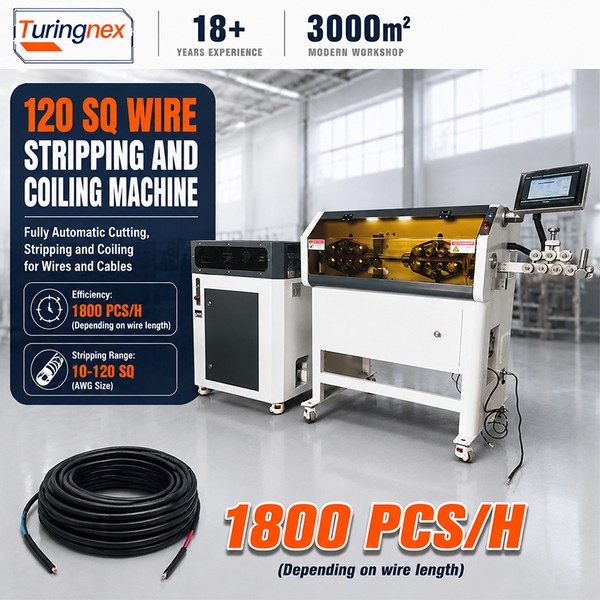
Family 4 — large-conductor strip and coil (10-120 mm2)
Big conductors do not bend like small wire: they need robust blades, powered feeding and, often, coiling after stripping. The TR-8120 automatic wire stripping and coiling machine covers the 10-120 mm2 range (roughly AWG 8 to 0000 depending on the conductor) — the class used for battery cables, welding leads and high-current harness branches.
Best for: heavy wire and cable where manual handling is slow and strip quality depends on blade and feed control, not muscle.
Choosing your family in four questions
| Question | Points to | Representative machine |
|---|---|---|
| Many short runs, one operator? | Family 1 — bench pneumatic | TR-QD15 |
| High volume, same recipe repeated? | Family 2 — computer single/two-end | TR-508-25ZW |
| Marking or in-line steps needed? | Family 3 — strip + marking | TR-8030YJP |
| Conductors from 10 to 120 mm2? | Family 4 — strip and coil | TR-8120 |
From family to decision
Once you know the family, the remaining decision is concrete: wire range, stripping length and blade quality. Two deeper guides cover the details — comparing computer-controlled versus pneumatic stripping, and large-wire stripping and coiling for 10-120 mm2. For technique on getting clean strips, see how to strip wire effectively.
FAQ
Can one machine cover two families? Partly — computer strippers handle a wide wire range, but bench pneumatic machines win on setup speed for mixed short runs, and large-wire machines need their own blade and feed class. Choose the family that matches your dominant job.
Which family is best for a new shop? Start with a bench pneumatic stripper if volumes are low and wires vary; move to computer-controlled once a few products run steadily. That sequence matches how most harness shops grow.
Do marking machines slow stripping down? Marking adds a step, but on an integrated machine like the TR-8030YJP the marking runs in the same cycle, so the line saves the separate print station it would otherwise need.
Bottom line
Start from the machine family that matches your wire range, batch pattern and finish requirements — bench pneumatic for flexibility, computer-controlled for repeatability, strip-and-mark for identified wires, and a 10-120 mm2 machine for heavy conductors. Tell us your wire range and daily volume; we will confirm the family and the specific machine, with sample strips run on your wire.