
Most "stripping problems" are not wire problems — they are blade and depth problems. A blade that is too deep nicks strands; a blade too shallow leaves insulation on the end; a worn or misaligned blade does both unpredictably. This guide covers the four settings that decide strip quality on real machines, from the TR-QD15 pneumatic bench stripper to computer-controlled machines such as the TR-508-25ZW and TR-8030YJP.

Setting 1 — blade depth: cut insulation, spare the copper
The blade must cut through the insulation and stop at the copper. The rule of thumb is to set depth slightly less than full wall thickness and confirm on a test piece: you should see a clean cut line on the insulation with no scoring of the strands underneath.
- Too deep: strands nick, and nicked strands fail flex tests later — invisible at the bench.
- Too shallow: the insulation tears instead of cutting, leaving fibres on the end.
Computer-controlled machines store depth per wire, which is why they repeat it across a shift; on a pneumatic bench machine, check depth whenever the wire diameter or insulation changes.
Setting 2 — blade condition: sharpen or replace on a schedule
Blades wear fastest where they contact the insulation, so the cut edge rounds over time. A rounded blade behaves like a shallow blade: it pushes the insulation instead of cutting it.
- Inspect blade edges weekly in daily production.
- Replace rather than sharpen V-blades once the edge rounds — regrinding changes the blade geometry and the depth setting.
Setting 3 — pull force and stripping length
After the blade cuts, the machine pulls the insulation off. Too little pull leaves a half-stripped end; too much pull on soft or braided insulation can stretch the conductor.
- Set the strip length for the terminal or process that follows — the stripped conductor must reach the full barrel depth with no insulation inside the crimp.
- On two-end machines like the TR-508-25ZW, verify both ends use the same recipe when the wire is processed symmetrically.
Setting 4 — alignment and feed
The wire must present square to the blades. Misaligned feed produces a diagonal cut that shortens one side of the stripped zone and can nick the far side.
- Keep guides matched to wire diameter — a loose guide lets the wire wander.
- For marking machines like the TR-8030YJP, check that the mark position is stable relative to the strip point; a drifting mark usually means the feed grip is wearing.
A practical 10-minute quality check
| Check | How | Pass condition |
|---|---|---|
| Depth | Strip a test piece, pull insulation off by hand | Clean cut line, no strand scoring |
| Blade | Look at the cut edge under light | No rounded or chipped edge |
| Strip length | Measure stripped zone | Matches recipe within 0.5 mm |
| Ends | Inspect both ends on two-end runs | Both ends identical, no fibres |
| Feed | Run 10 pieces at full speed | Strip position stable across all 10 |
Why the machine class matters
The same technique applies everywhere, but machines enforce it differently:
- TR-QD15 — pneumatic bench machine: the operator owns depth and alignment on every setup; fast for mixed short runs.
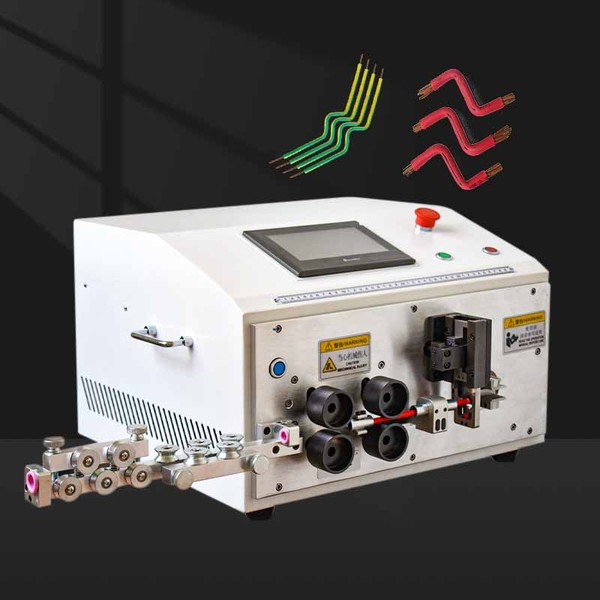
- TR-508-25ZW — computer two-end stripper: recipes hold depth, length and pull so a verified setting repeats on every piece.
- TR-8030YJP — computer stripper with marking: adds mark-position consistency to the strip recipe.
For a wider view of which family fits your production, see our guide to wire stripping machine families and the computer-versus-pneumatic comparison.
FAQ
How often should I check stripping depth? At every setup change and at least daily in steady production. Insulation hardness varies between batches, so a recipe that was right last week can be off on new wire.
Is it better to strip slightly shallow and adjust? Yes — start shallow and increase depth until the cut is clean. Going from deep down damages wire while you search; going shallow up damages nothing.
Do blades need different settings for solid and stranded wire? Yes. Stranded wire is more sensitive to depth (the blade can enter between strands); solid wire tolerates a slightly deeper cut. Store separate recipes where the machine supports them.
Bottom line
Clean stripping is a blade-depth problem solved with four disciplines: correct depth, sharp blades, right pull and square feed. Choose the machine class that enforces those disciplines at your volume — operator control on the bench, or stored recipes on computer machines. If stripping quality is costing you scrap, send us a wire sample and a failed part; we will show you the setting that fixes it on our machines.