
Every harness automation forecast lists the same words — robotics, data, integration — but the practical question for a machine buyer is narrower: what does this year's machine actually do differently at the workstation? This article looks at four concrete automation trends and the machine capabilities behind them, using Turingnex machines as the reference points.
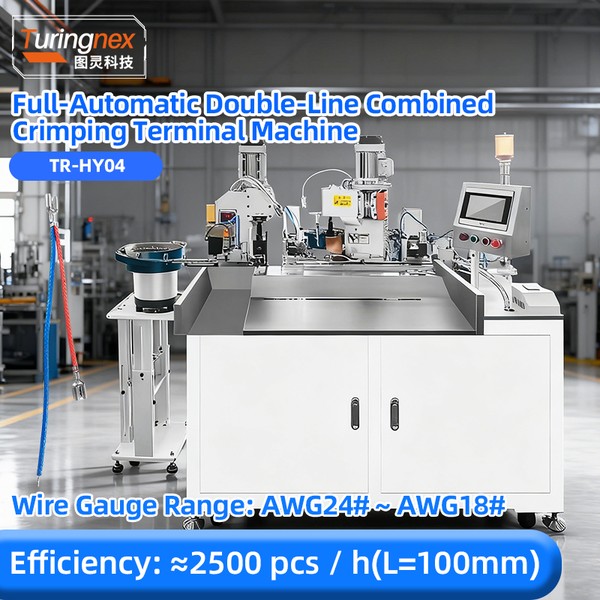
Trend 1 — feeding and handling become the machine
The first automation step is not a robot; it is feeding. Automatic machines that pull wire from reels, feed terminals from reels and eject finished leads remove the handling time between stations. The TR-HY03 fully automatic three-in-one terminal crimping machine (wire feed, cut, strip, crimp in one cycle, rated around 2,200-2,500 pcs/h — see the product page for range details) is the volume benchmark of this trend: one operator supervises what two or three manual stations used to produce.
Trend 2 — one machine, multiple finished processes
Instead of a machine per process, new equipment combines process variants in one station with recipe switching. The clearest example in protector welding is the dual-mode TR-WK02, which welds thermal protectors with or without tin dipping (non-tinning up to 850 pcs/h, tin-dipping up to 700 pcs/h — product page for full data). In stripping, machines like the TR-8030YJP add in-line marking to the strip recipe. Recipe-based multi-process machines shrink the line footprint and the inventory of dedicated stations.
Trend 3 — force data moves from audit to process control
Servo-driven presses made force monitoring possible; the trend now is treating that data as process control, not just documentation. The TR-SG20T-40T intelligent servo terminal crimping machine monitors force through the stroke and logs per-cycle data, so a missing strand or worn die is caught in the press rather than in a later test. For EV and battery interconnects this turns the machine into a quality gate.
Trend 4 — process chains integrate around the connector
The newest machines are not faster presses; they are complete process cells. Sealed-connector production now arrives as chains — NTC arranging and lead welding (TR-GY01), copper-strip riveting and tinning (TR-NTC), and protector welding (TR-WK02) — and insertion machines bring the plug and shell into the same flow (waterproof plug insertion machines). Buying the chain from one supplier keeps workpiece formats and process responsibility consistent.
What to expect when you evaluate a machine in 2026
| Automation claim | What to verify |
|---|---|
| "Fully automatic" | Which steps are truly in-line (feed/cut/strip/crimp) vs. manual between stations |
| "Dual-mode / multi-process" | Recipe switching without re-tooling — ask for changeover time |
| "Force monitored" | Full-curve logging or peak force only; data export format |
| "Integrated line" | Do the stations share workpiece formats and one process owner? |
Reading list by machine type
These trends map to the guides organised on our blog by machine type:
- Terminal crimping machines by family — where the feeding trend lives
- Semi-automatic versus fully automatic — the volume economics
- Servo versus pneumatic drives — force data explained
- Thermal protector welding trends — dual-mode and chain automation in one product family
FAQ
Is robotics the main automation trend for harness shops? For most mid-volume shops, no — feeding and recipe-based multi-process machines deliver more output per euro than robots, and are easier to programme. Robotics pays off at very high volumes or for tasks like shell handling that are hard to feed.
Will these machines work with my existing terminals and wire? Automatic machines need reel-fed wire and applicable dies/applicators for your terminals. That is standard, but confirm applicator compatibility before purchase.
How much automation should a growing shop buy? Buy the next step, not the final vision: add feeding where handling dominates, add a servo machine when a customer asks for force data, and integrate process chains only when volumes justify it. Each guide on this page sizes that step.
Bottom line
2026 automation is feeding, multi-process recipes, force-based process control and integrated connector chains — not automation for its own sake. Evaluate machines against those four claims, buy the next step your volume and customer requirements justify, and use the machine-type guides on this blog to size each step. Tell us your current line and target output; we will map which of these trends pays for itself first in your shop.