
A "terminal crimping machine" covers presses with very different economics: a bench press for job-shop runs, a fully automatic line machine for harness volume, and a servo press for force-controlled, documented crimps. Choosing starts with the family, not the brand. This guide maps the four families to real machines and the jobs each one fits.
Family 1 — semi-automatic bench presses: flexibility at low volume
The TR-JD22 semi-automatic mute terminal crimping machine represents the workhorse of this family: an operator feeds the terminal and wire, the press crimps quietly, and changeover between terminal sizes is a die swap. Low noise (mute drive) matters in shops where presses sit next to assembly benches.
Best for: small batches, many terminal changes per day, repair and prototyping, and as the second press beside an automated line.
Family 2 — fully automatic crimping machines: volume in one pass
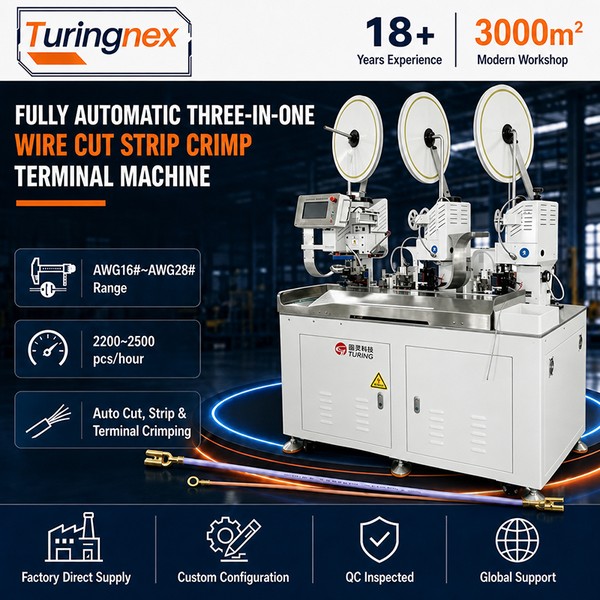
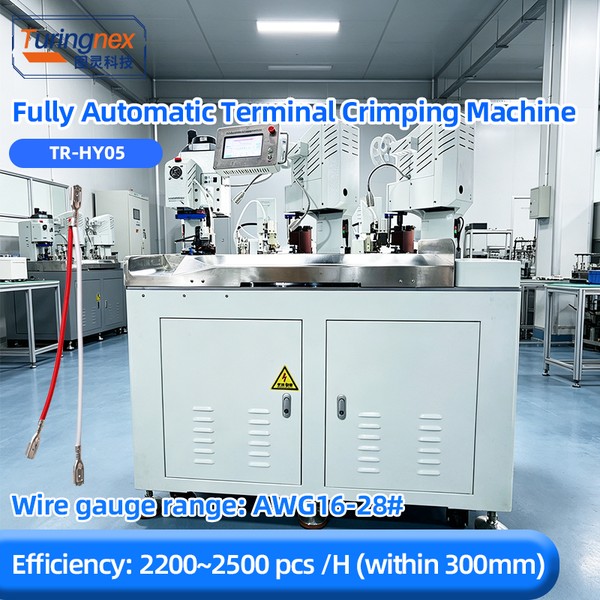
When thousands of identical leads run per day, the machine should take the wire in and deliver the crimped lead out. Fully automatic machines feed wire, cut, strip and crimp in one cycle. The TR-HY03 fully automatic terminal crimping machine is the three-in-one reference of this family, rated around 2,200-2,500 pcs/h (see product page for range details) — the class that replaces two or three manual stations.
Best for: high-volume harness production where wire comes from the reel and the terminal from a reel-fed applicator.
Family 3 — servo presses: force control and documentation
The TR-SG20T-40T intelligent servo terminal crimping machine belongs to the servo family: closed-loop force through the stroke, in-stroke monitoring and crimp data per cycle. It is the machine to choose when the customer asks for force records, or when terminals are large enough (10-120 mm2 class work) that a missed strand or unseated terminal must be caught in the stroke.
Best for: EV/high-voltage and battery interconnects, audited quality lines, large tubular terminals.
Family 4 — specialist configurations: sealed connectors and solder-seal
Beyond the basic press families, harness work adds process-specific machines: inserting waterproof plugs and shells (waterproof plug insertion machines) and crimp-solder-seal for waterproof soldered joints (fully automatic crimp-solder-seal machines). If your parts are sealed connectors, the insertion step often decides the machine choice more than the crimp itself.
Choosing your family
| Your situation | Family | Representative machine |
|---|---|---|
| Small batches, frequent die changes | Semi-auto bench | TR-JD22 |
| Thousands of identical leads/day | Fully automatic three-in-one | TR-HY03 |
| Force data required or large terminals | Servo press | TR-SG20T-40T |
| Sealed/waterproof connectors | Insertion or solder-seal specialist | See insertion machines |
From family to model
Once the family is right, compare within it: terminal range and dies, cycle rate, applicator compatibility, and setup time. Two deeper guides cover the economics — semi-automatic versus fully automatic machines and servo versus pneumatic drives — and a separate guide covers keeping any of these presses in condition.
FAQ
Can one fully automatic machine handle many terminal types? Only with the right applicator and die set per terminal; changeover is slower than on a bench press. That is why high-mix shops keep a semi-auto press beside the automatic line.
Is a servo press always better than a pneumatic press? Not always — for simple terminals at low volume, a semi-auto press is cheaper and simpler. Servo earns its premium where force data or large conductors are involved. See our servo versus pneumatic comparison.
How do I know my terminal needs the three-in-one machine? If the lead needs cutting and stripping before crimping and the wire comes from reels, the three-in-one flow removes two handling steps. If wire arrives pre-cut and stripped, a plain crimp press may be enough.
Bottom line
Match the press family to the job: bench semi-auto for flexibility, fully automatic three-in-one for volume, servo for force-controlled documented crimps, and specialist machines for sealed connectors. Send us your terminal samples, wire range and monthly volume — we will recommend the family and the exact model, with sample crimps and pull-test results to confirm.